Religious Studies
For more curricular information contact info@clwacademy.org.uk
Curriculum intent
Our intention is for students to learn more about themselves, their community, society and the world. It is very much a thinking subject founded in a knowledge of people’s beliefs (religious and non-religious) regarding life, how to live and key issues in our society and world. It encourages philosophical thought, decision-making skills, collaboration and independent working skills and the search for compromise and conflict resolutions that work.
All children and young people need to acquire core knowledge and understanding of the beliefs and practices of the religions and worldviews which not only shape our shared history and culture, but which guide their development. The modern world needs young people who are confident in their own beliefs and values, so that they can respect the religious and cultural traditions of others.
KS3
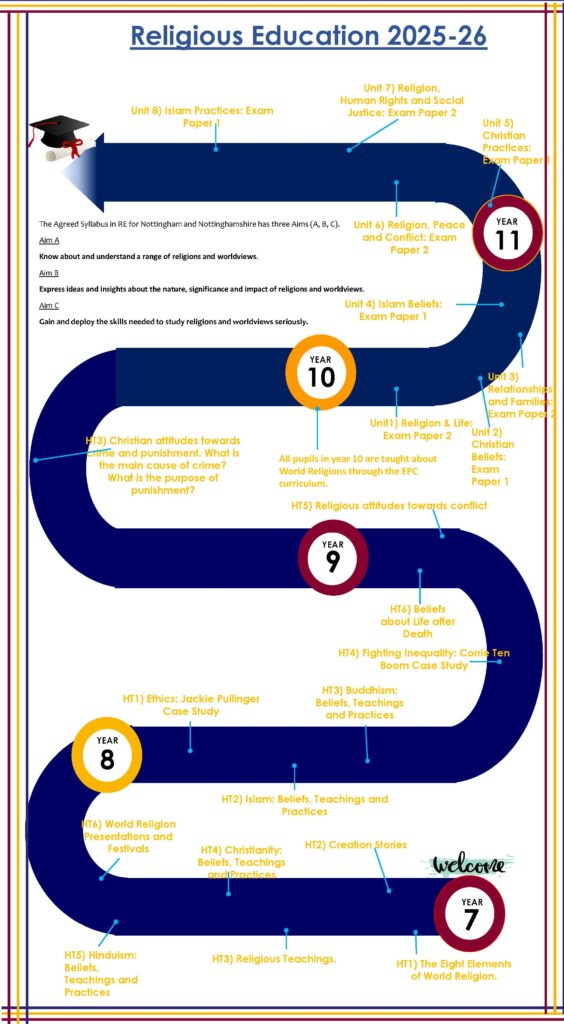
At Key Stage 3 students will study the Nottinghamshire and Nottingham City Agreed Syllabus – Religious Education for ALL.
The syllabus requires that all pupils learn from Christianity in each key stage. In addition, pupils will learn from the principal religions represented in the UK; Islam, Hinduism, Sikhism, Buddhism and Judaism. Furthermore, children from families where non-religious worldviews are held are represented in all activities.
KS4
At Key Stage 4 students can opt to take Religious Studies as one of their GCSE options.
We study the AQA Religious Studies syllabus. Content includes:
Christianity and Islam religious ethics:
- Medical ethics – including the issues of abortion, euthanasia, suicide and other issues
- Relationships – including views on marriage, services, divorce, civil partnerships and sex
- War, peace and human rights – including the Just War Theory
- Prejudice and equality – including racism, sexism and the issue of women priests
- Crime and Punishment- including death penalty, corporate punishment, types of crimes and good and evil
Religious Philosophy:
- Good and evil – how can there be a loving and all powerful God when there is evil?
- The end of life – beliefs about the afterlife funerals and mourning
- Belief about deity – Trinity and 99 names of Allah, arguments about God & miracles
- Religion and science – what are religious and scientific views on how the world started?
| Pedagogy | Enrichment | Other General Principles |
| The delivery of Religious Education is non-dogmatic and non-bias. Humanist, scientific and atheist arguments are welcomed and fully explored. Retrieval practice takes place weekly. To reduce cognitive load new learning is linked to the eight elements of religion; Rituals, Sacredness, Community, Beliefs, Ethics, Emotions, Objects and Symbols, Stories. RE offers distinctive opportunities to promote pupils’ spiritual, moral, social and cultural development (SMSC). RE lessons offer a structured and safe space during curriculum time for reflection. Follow the agreed syllabus for RE in Nottingham City and Nottinghamshire – Religious Education for All. | Visits and visitors: RE is the ideal vehicle for building links with faith communities in the local area of the school. Pupils have opportunities to meet people of different faiths and cultures to develop a respect for those who believe, think and practice differently, without feeling that their own identity or views are threatened. Rich knowledge, open minds: An ambitious RE curriculum can give pupils the kinds of rich knowledge of religions and worldviews that enable them to participate fully in the cultural life of modern diverse Britain. RE opens minds to global diversity and cultures. Cultural Competences: Effective RE enables pupils to develop cultural competency and cultural navigation skills from their own worldview or religion in relation to the religions and worldviews of others. Engaging with Cultural and Religious Diversity: Effective RE enables all pupils to understand the significance of spiritual and moral issues in our contemporary culture, so that they can both contribute to and benefit from the multicultural society in which they live. Access for All: RE gives pupils from every background access to the kinds of cultural capital with which religions and worldviews engage – e.g. in the arts, language, literature, sciences, sport, fashion and the economy in all its aspects. This includes the ways religions and worldviews challenge prevailing ideas, e.g. from moral perspectives. | RE provokes challenging questions about meaning and purpose in life, beliefs about God, ultimate reality, issues of right and wrong and what it means to be human. RE makes a key contribution to enabling pupils to consider British values, including tolerance and respect for people who hold different faiths and worldviews. In RE our students learn to weigh up for themselves the value of wisdom from different communities, to disagree respectfully, to be reasonable in their responses to religions and worldviews and to respond by expressing insights into their own and others’ lives. RE undoubtedly supports pupils and students for life in the ‘modern world’. In addition, it develops the following skills: – Clear and logical thinking – Critical evaluation – Literacy and expression – Negotiating – Organising – Planning – Problem solving – Research |
KS5
Students may decide to continue their Religion and Philosophy studies into Key Stage 5. We study Religious Studies using the OCR board syllabus.

Right of Withdrawal from Religious Studies
At Carlton le Willows Academy we wish to be an inclusive community but recognise that parents have the legal right to withdraw their children from Religious Education on the grounds of conscience. This would be following consultation with the Academy.