Mathematics
For more curricular information contact info@clwacademy.org.uk
Curriculum intent
“Without mathematics, there’s nothing you can do. Everything around you is mathematics. Everything around you is numbers”
Shakuntala Devi, Indian writer and mental calculator
Curriculum Intent
Our intention, through studying Maths, is to provide our pupils with the knowledge and skills that will enable them to be successful in a wide range of fields, whatever their future career holds. Mathematics is essential to everyday life, critical to science, technology and engineering, and necessary for financial literacy and most forms of employment. We have a well-constructed curriculum, tailored to meet the needs of our learners which provides a foundation for understanding the world, the ability to reason mathematically, an appreciation of the beauty and power of mathematics, and a sense of enjoyment and curiosity about the subject.
We believe that students deserve a creative and ambitious mathematics curriculum, rich in skills and knowledge, which ignites curiosity and prepares them well for everyday life and future employment. Our mathematics curriculum will give students the opportunity to:
- become fluent in the fundamentals of mathematics, through varied and frequent practice with increasingly complex problems over time, so that pupils develop conceptual understanding and the ability to recall and apply knowledge rapidly and accurately;
- reason mathematically by following a line of enquiry, conjecturing relationships and generalisations, and developing an argument, justification or proof using mathematical language;
- can solve problems by applying their mathematics to a variety of routine and non-routine problems with increasing sophistication, including breaking down problems into a series of simpler steps and preserving in seeking solutions;
- can communicate, justify, argue and prove using mathematical vocabulary;
- develop their character, including resilience, confidence and independence, so that they contribute positively to the life of the school, their local community and the wider environment
All pupils’ complete homework through Sparx, an intelligent homework system which creates a profile of each student’s ability level, working speed and activity on specific topics. This allows pupils to complete homework at appropriate levels to further their progress and understanding.
KS3
The programme of study for Key Stage 3 is sequenced to build on knowledge gained in Key Stage 2 and build connections across mathematical ideas to develop fluency, mathematical reasoning and competence in solving increasingly sophisticated problems.
KS4
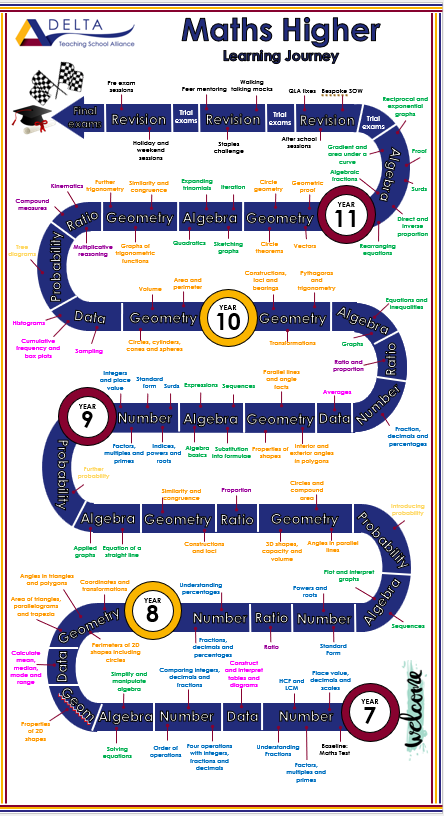
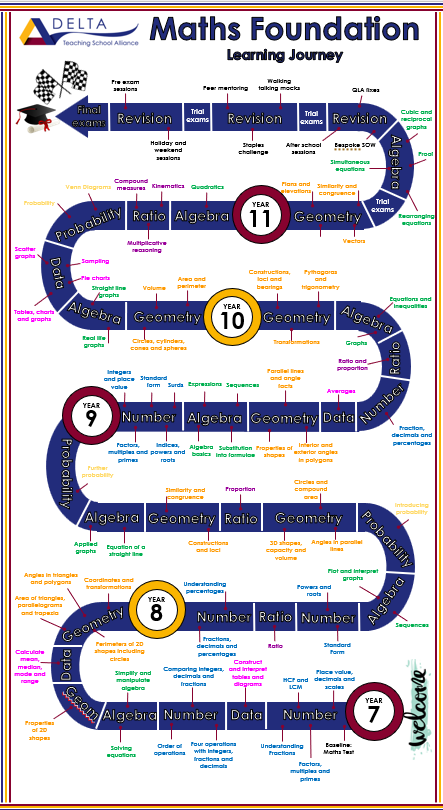
At Key Stage 4 students study towards the new 9-1 GCSE Maths. The Key Stage 4 scheme of work starting in Year 10, is split into different strands. At KS3 students will have already built competence at these strands of maths. Our awareness of this comes through regular assessments and through teacher judgement. The overlap in the higher and foundation schemes of work means that students are not restricted to a higher paper or foundation paper at an early stage.
We study the Edexcel board which is three 90 minute papers, one non-calculator and the other two calculator. We run weekly, dedicated Year 11 after school support sessions for extra help and support with homework, class work or revision.
To learn more about the sequence of learning please see the learning journeys below.
KS5
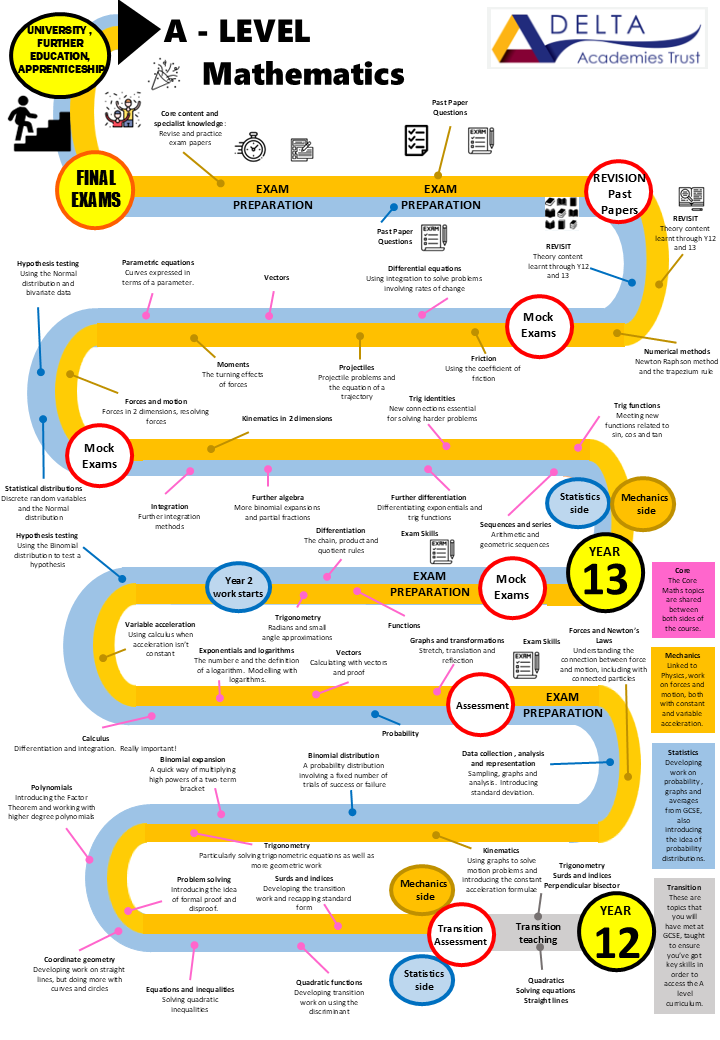
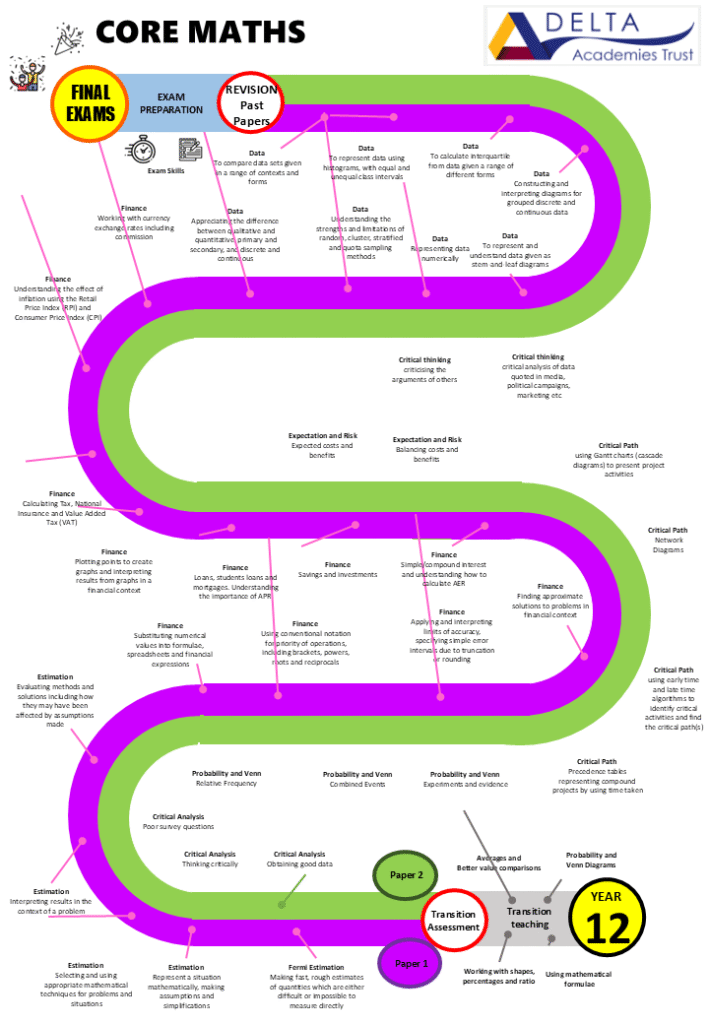
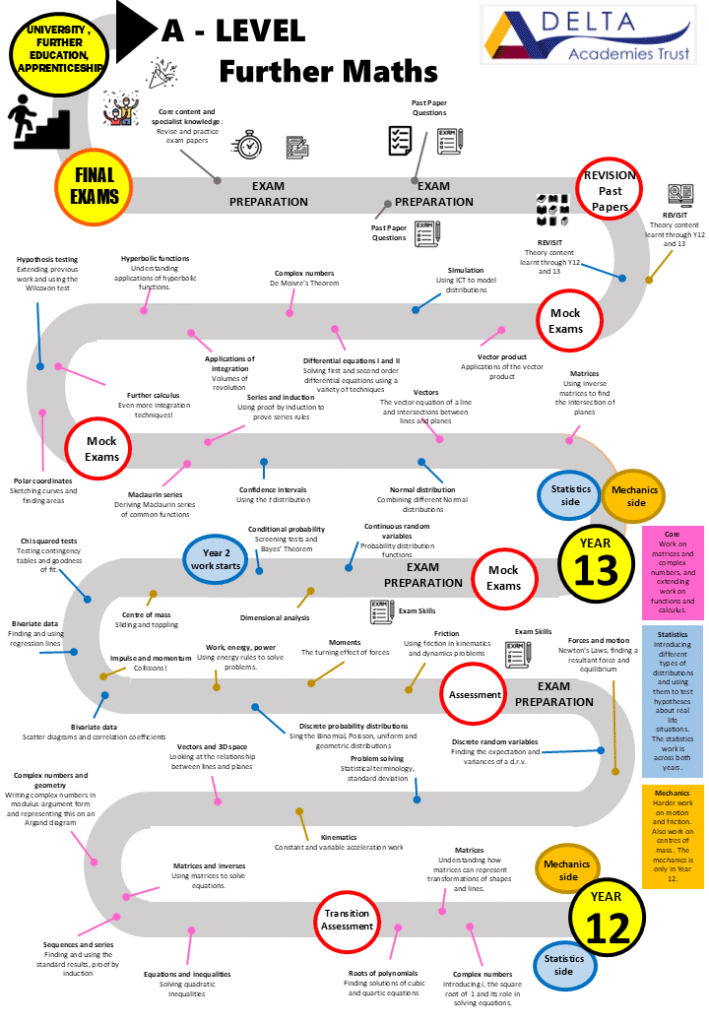
At Key Stage 5 we offer A Level Mathematics with Statistics and Mechanics, as well as A Level Further Maths and a Core Maths qualification.
A level Maths (entry requirement Grade 7 or above at GCSE)
A-level Mathematics is an interesting and challenging course which extends the methods learned at GCSE and includes new applications of mathematics such as Statistics and Mechanics. We study OCR Mei which is assessed through three two-hour exams at the end of year 13 – Pure Mathematics and Mechanics; Pure Mathematics and Statistics (both 36.4% of total A-level) and Pure Mathematics and Comprehension (27.3% of total A-level). The reason so many employers value mathematics qualifications so highly is that students become better at thinking logically and analytically. Through solving problems you develop resilience and are able to think creatively and strategically. The writing of structured solutions, proof and justification of results helps you formulate reasoned arguments. Importantly you will have excellent numeracy skills and the ability to process and interpret data.
A-level Further Maths (entry requirement Grade 8 or above at GCSE)
Further Mathematics is a valuable qualification which gives added insight into how mathematics develops and why it is useful. The A-level consists of one mandatory core paper, with additional papers in Statistics and Mechanics. There are three exams at the end of year 13 – 2hrs 30mins Core paper (50% of total mark); 2hrs 15mins Statistics Option paper (33.33% of mark) and 1hr 15mins Mechanics Option paper (16 2/3% of total A-level mark). Students who wish to take Further Mathematics must take it in addition to A level Mathematics. It is for students who excel at GCSE and wish to take their Mathematics deeper in preparation for Maths-related degrees.
Core Maths (entry requirement Grade 5 or above at GCSE)
Level 3 Mathematical Studies AQA (Core Mathematics) is a new qualification designed for students who have achieved a grade 5 or above at GCSE and who want to continue mathematical studies of some sort without the high demands of an A-level. There are two exams of 1hour 30 minutes (60 marks each) Paper 1 covers Mathematics for personal finance, while Paper 2 is Analysis of data and evaluation of risk. Core Maths helps to develop students’ mathematical skills and thinking and supports courses such as A-level Psychology, Sciences and Geography as well as technical and vocational qualifications.
| Pedagogy | Enrichment | Other general principles |
| Our pedagogy is underpinned by: a mastery approach to the teaching of mathematics for understanding; a spiral curriculum basing future teaching on the building blocks taught previously; concepts that are broken down into small connected and structured steps enabling application to range of contexts; variation to develop deep and holistic understanding; procedural fluency and repetition of key facts to free up working memory; marking and feedback that informs planning and addresses misconceptions promptly; questioning planned intelligently; interventions that are timely, planned and effective from Trust wide unified assessments; students who see error as a learning opportunity and are resilient in their learning; constant focus on fact retrieval; opportunities for pupils to reason and justify. | We will enrich our curriculum by: offering further opportunities for students to study mathematics with GCSE Further Mathematics; establishing cross-curricular links especially through the learning of numerical skills and application in other areas; holding Trust-wide competitions and participating in national competitions (such as Maths challenge at Junior, Intermediate and Senior level) to celebrate best work and extraordinary effort; using external resources to enhance and support independent learning and revision; the experience of practical implementation of mathematics in everyday life for financial and numerical confidence and security; celebrating Pi Day on 14 March (with inter-form Pi recital) as a link to the History of Mathematics and promoting positive and memorable experiences in the classroom; opportunities to promote STEM and further/higher education learning and careers;·giving pupils the opportunity to mentor/be mentors by their peers. | Our curriculum will enable students to: learn within a coherent and exciting framework which does not limit students ambitions; develop new skills through a variety of interesting contexts to foster enjoyment; develop a rich, deep and secure subject knowledge; understand what they are doing well and how they need to improve; explore the breadth and depth of the national curriculum; build on their understanding of the importance of British values, including democracy, the rule of law, individual liberty and tolerance and respect; improve their spiritual, social, moral and cultural understanding to develop confidence in their own financial and numerical understanding. |