Art
For more curricular information contact info@clwacademy.org.uk
Curriculum intent
“Creativity takes courage”
Henri Matisse
Students that study Art at Carlton le Willows will be provided with the essential art knowledge and skills to succeed and be prepared for life after school. Our intention, therefore, is to not only develop a love of art, photography, textiles, graphical communication and 3D design for its creativity, problem solving and critical thinking, but also to build the essential skills needed such as research, analysis, synthesis, evaluation and critical judgement, encouraging self-expression, creativity and confidence, as well as a sense of individual identity. Our ambition is to create the very best artists, designers, photographers and free thinkers, who act and speak like those working in the creative industry.
KS3
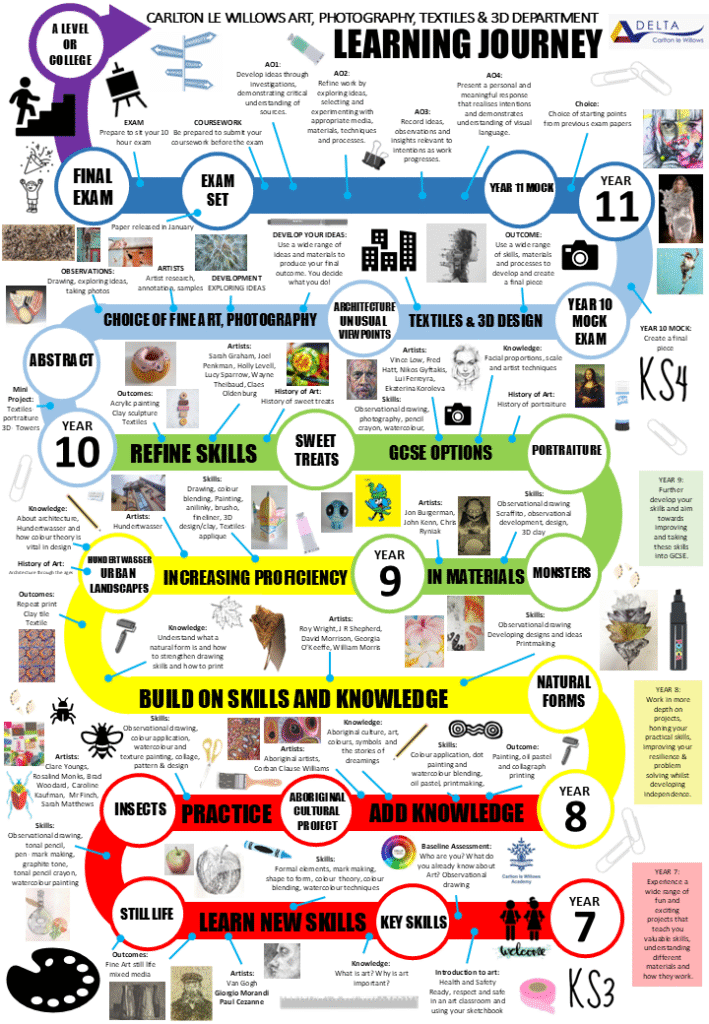
At Key Stage 3, students are taught in mixed-ability groups and receive one one-hour Art and Design lesson per week. The curriculum is designed to provide a broad, engaging introduction to the subject and to build the skills, knowledge, and confidence required for progression to GCSE courses in Fine Art, Photography, Textiles, Graphic Communication, and 3D Design.
Throughout Years 7 to 9, students explore a wide range of artistic disciplines, including drawing and painting, graphical drawing, printmaking, textiles, ceramics, and critical studies. Learning is carefully sequenced so that students revisit key skills and concepts with increasing independence and challenge as they move through the key stage.
A strong emphasis is placed on the formal elements of art — line, tone, form, colour, and shape — and on how these are applied across different materials and processes. Students are taught how to research artists and designers, explore the use of media and techniques, experiment with ideas, and record their work effectively. They are encouraged to develop their own creative responses and personal style, helping them to grow in confidence and artistic maturity.
Students record their learning in A5 sketchbooks, which they use throughout Years 7–9, alongside larger design sheets and final outcomes. Sketchbooks are used to document research, observational drawing, experimentation, skill development, and reflection. Students complete two projects per year, ensuring experience across a range of media and subject areas that link to GCSE assessment objectives.
Lessons promote a calm, purposeful working environment where students are encouraged to work independently, take creative risks, and develop resilience. Teaching is inclusive and carefully planned to engage learners of all abilities. Enrichment opportunities are available through after-school art clubs, where students can further develop skills, pursue personal interests, and work more independently.
KS4
At Key Stage 4, students can choose to study GCSE qualifications in Fine Art, Photography, Graphic Communication, Textile Design, and 3D Design within the Art and Design department. Students may opt to study one or a combination of these subjects. Each GCSE option is allocated two one-hour lessons per week per subject.
The department delivers the AQA GCSE specifications in all Art and Design pathways. Each course is a two-year programme that develops students’ practical skills, creative thinking, and understanding of visual culture. Students build on the foundations established at Key Stage 3, refining their ability to observe, record, experiment, and create personal, meaningful outcomes using a wide range of materials, techniques, and processes.
Across all GCSE pathways, students engage in art appreciation and critical studies, exploring the work of artists, craftspeople, and designers from a range of contexts. This research informs their practical work and supports the development of strong compositional skills, creative problem-solving, and an increasingly independent approach to their projects.
Students record their work in sketchbooks of varying sizes, alongside design sheets and final outcomes in a range of forms appropriate to their chosen discipline. Emphasis is placed on sustained project development, experimentation, refinement, and reflection in line with GCSE assessment requirements.
Assessment follows the AQA GCSE Art and Design structure, with 60% of the final grade awarded for the Portfolio (coursework) and 40% for the Externally Set Assignment, which concludes with a 10-hour supervised practical examination in which students produce a final outcome.
The Art and Design GCSE options are a popular choice among students. High levels of engagement and commitment are reflected in strong examination outcomes, and students’ achievements are celebrated through an end-of-course exhibition, showcasing work from across all disciplines.
KS5
At Key Stage 5, students can choose to study A-level Art and Design within the department. Courses are offered in line with student demand and typically include pathways such as Fine Art, Photography, Textile Design, Graphic Communication, and 3D Design, building directly on the GCSE Art and Design experience.
A-level Art and Design is a two-year course that allows students to develop a highly independent and personal approach to their creative practice. The curriculum is designed to extend students’ technical skills, conceptual thinking, and critical understanding, preparing them for further study in creative subjects or progression into creative industries.
Students explore a wide range of media, techniques, and processes appropriate to their chosen specialism, while developing increasingly sophisticated skills in observation, experimentation, refinement, and presentation. Strong emphasis is placed on research and contextual understanding, with students analysing the work of artists, designers, and practitioners to inform and support their own creative decisions.
A central element of the A-level course is the Personal Investigation, which accounts for 60% of the final grade. This is a sustained, self-directed project in which students identify a personal theme or concept, develop ideas through practical experimentation, and produce a final outcome supported by a written critical study. The Personal Investigation enables students to demonstrate independence, originality, and depth of understanding, and encourages them to take ownership of their creative journey.
The remaining 40% of the qualification is awarded through the Externally Set Assignment, which concludes with a 15-hour supervised practical examination. This component allows students to respond creatively to a set starting point, applying the skills, knowledge, and independence developed throughout the course.
Students record their work in sketchbooks, journals, digital formats, and larger design sheets, alongside resolved outcomes appropriate to their chosen discipline. Regular critique, reflection, and refinement support the development of confident, articulate, and resilient creative practitioners.
A-level Art and Design students are highly motivated and committed, and their work is celebrated through exhibitions and showcases. The course supports progression to art foundation courses, university degree programmes, apprenticeships, and careers within the creative industries, equipping students with strong visual, analytical, and independent learning skills.
| Pedagogy | Enrichment | Other general principles |
| Our Art and Design curriculum provides students with opportunities to be creative and to develop personal and meaningful responses to a wide range of subjects, themes, and issues through the use of diverse materials, techniques, and processes. Teaching is designed to develop enjoyment of the subject, while building a rich and deep subject knowledge that supports long-term progress. Our pedagogy is underpinned by: The regular use of live demonstrations, teacher modelling, and carefully selected examples of high-quality pupil work, which are used to clearly demonstrate processes, standards, and expectations. A range of strategies to deepen knowledge and ensure it is committed to long-term memory, including structured practice, repetition, drill tasks, and tasks that encourage students to connect skills, techniques, and contextual understanding. The development of new skills through engaging and varied concepts, ensuring that lessons remain stimulating and enjoyable while maintaining appropriate challenge for all learners. Frequent verbal feedback and dialogue, enabling pupils to understand what they are doing well and how they can improve, supporting reflection, refinement, and increasingly independent decision-making. This approach supports the development of confident, skilled, and reflective learners who can apply their knowledge creatively and with increasing independence as they progress through the Art and Design curriculum. | The Art and Design curriculum is enriched through a wide range of experiences that broaden learning, foster creativity, and develop cultural understanding. Pupils benefit from opportunities that extend beyond the classroom, support personal growth, and connect their learning to the wider world. Enrichment includes: Cross-curricular links, allowing pupils to make connections between Art and other subjects, deepening understanding and creativity. On-site and off-site experiences, including gallery visits, workshops, and field trips, to inspire practical and contextual learning. Competitions and showcases, including Trust-wide events, which celebrate high-quality work and extraordinary effort. Community engagement, encouraging pupils to contribute to the life of the school and wider community, for example through Remembrance activities and local initiatives. Partnerships with external providers, such as local artists, galleries, and primary schools, which extend pupils’ opportunities for learning and collaboration. Development of British values, including democracy, the rule of law, individual liberty, and mutual respect, integrated meaningfully into projects and activities. Spiritual, social, moral, and cultural understanding, ensuring pupils gain awareness of diverse perspectives and cultural contexts through their creative work. Through these enrichment opportunities, pupils develop confidence, independence, and a deeper appreciation of Art and Design, preparing them for success within school, in further education, and beyond. | Our Art and Design curriculum is designed to ensure that pupils: Develop as independent, confident learners who can take ownership of their creative work. Learn within a structured framework, building skills progressively and exploring both the national curriculum and relevant exam board specifications. Foster enjoyment of the subject while developing knowledge, practical skills, and creative thinking. Appreciate the benefits of studying the arts for their personal growth, future education, and career opportunities. Understand what they are doing well and how to improve, supported by regular feedback and reflection. Build on their understanding of British values and enhance their spiritual, social, moral, and cultural development. Develop character, resilience, and confidence, enabling them to contribute positively to the life of the school, local community, and wider environment. Have opportunities to take part in art competitions and exhibitions, celebrating achievement and creativity. |