Business Studies
For more curricular information contact info@clwacademy.org.uk
Curriculum intent
At Carlton le Willows our intent is to provide students with a practical, engaging and relevant curriculum that equips them with the knowledge, skills and
behaviours needed to succeed in education and beyond. The courses are designed to inspire entrepreneurial thinking, develop real-world enterprise skills and support students in becoming confident, resilient and informed decision-makers. We believe students should receive a broad and ambitious Business curriculum, rich in skills and knowledge, which ignites curiosity and prepares them well for future learning or employment.
KS4
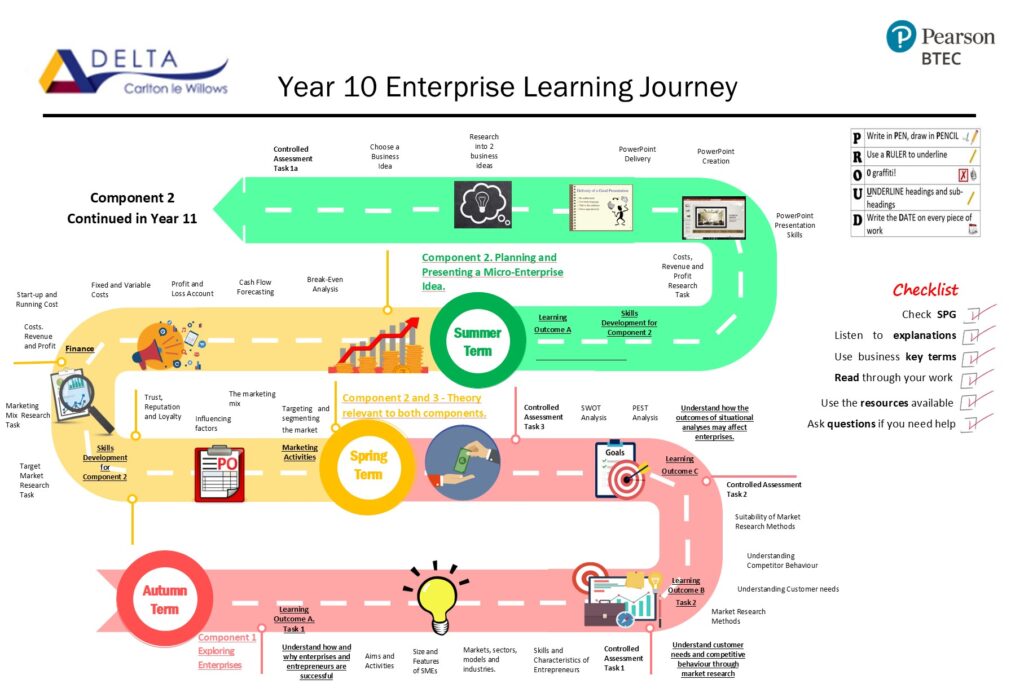
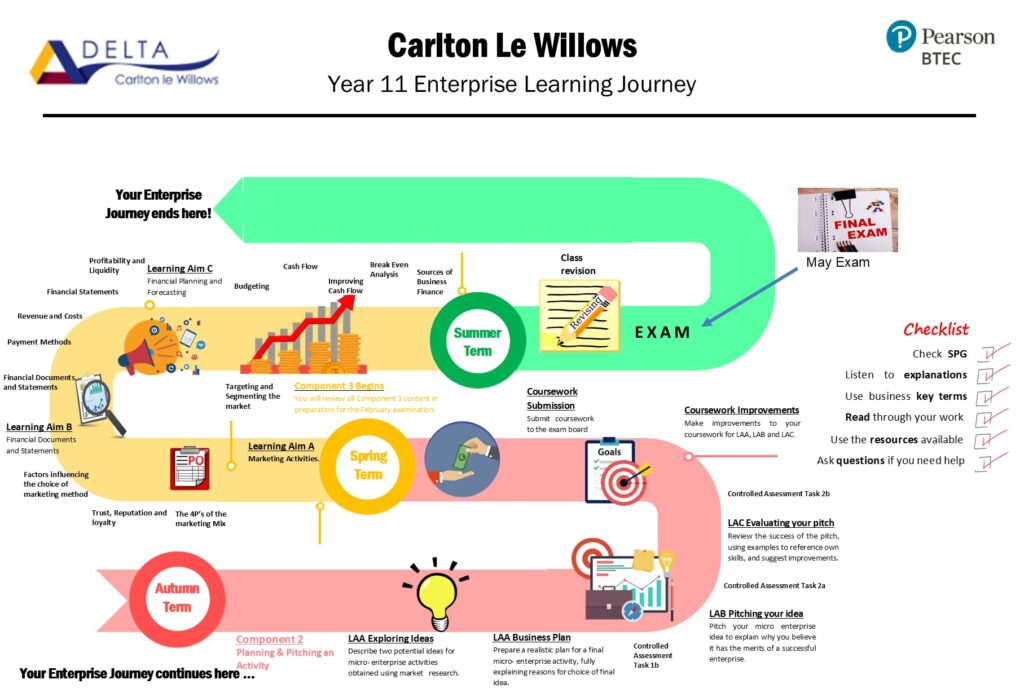
We follow the Pearson BTEC Tech Award in Enterprise and we give students the opportunity to:
- gain a secure understanding of how businesses operate, the importance of innovation, and the role of enterprise in local, national and global economies.
- build knowledge of enterprise ideas, market research, business planning, finance, marketing and pitching, enabling them to understand how entrepreneurial activity can create value for individuals and society.
- develop literacy, numeracy and digital skills, which are embedded throughout the curriculum, to ensure preparation for further education, apprenticeships or employment.
- develop a strong work ethic and an enterprising mindset, enabling them to make informed choices about their future pathways and contribute positively to the economy and wider society.
- use their developed analytical and evaluative skills to read and answer case study-based questions, with a coherent structure, clear argument and justified conclusions.
- apply theoretical concepts to real life situations which facilitates discussion and engagement.
- promote an inquisitive and questioning mind-set that does not automatically accept ideas and opinions at face value;
- to differentiate all lessons to help support learners of all ability and enable all students to fulfil their potential
- use a wide range of appropriate business terminology to improve precision and understanding of the business environment
- develop their character, including resilience, confidence and independence, so that they contribute positively to the life of the school, and the wider environment.
KS5
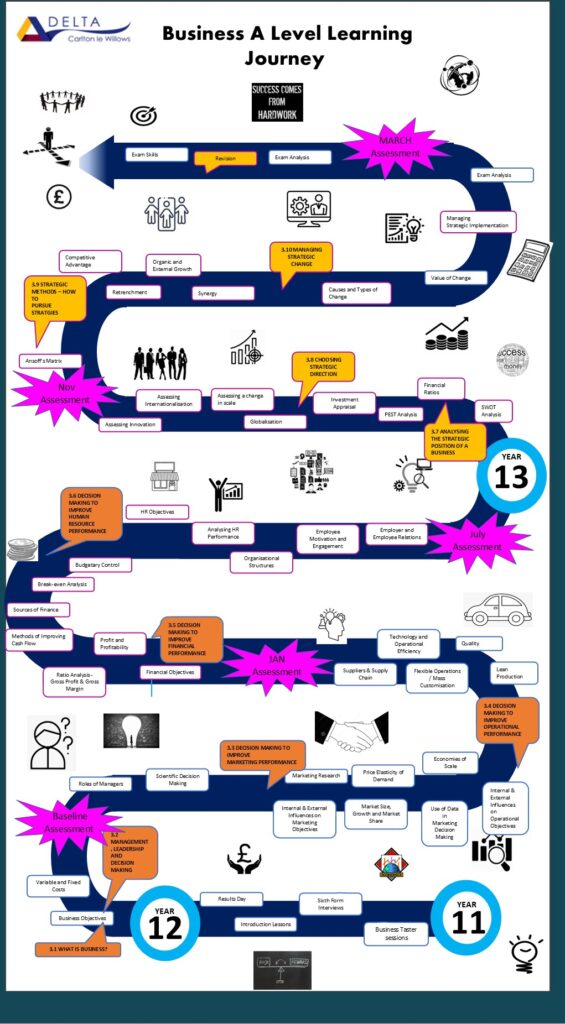
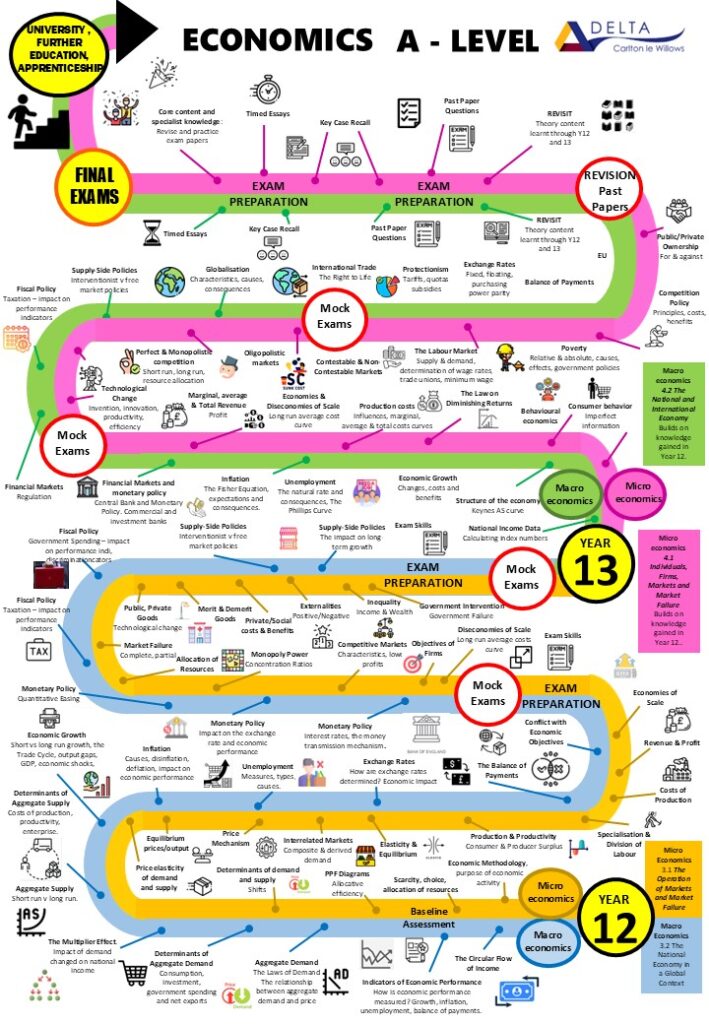
We follow the AQA A Level Business Studies specification, AQA A Level Economics specification and the Cambridge Technical in Business Level 3 Specification. Our curriculum is designed to build powerful disciplinary knowledge across the key functional areas of business — marketing, finance, operations, human resources and strategy — while embedding a strong understanding of external influences such as economic conditions, technological change, ethical considerations and government policy. Content is carefully sequenced from foundational concepts in Year 12 to more complex strategic and evaluative thinking in Year 13, ensuring students can make connections across topics and apply their learning synoptically.
- We place a strong emphasis on developing analytical, evaluative and quantitative skills, enabling students to interpret data, assess financial information, and construct well-reasoned arguments supported by evidence.
- Students are regularly exposed to real-world business contexts and contemporary case studies to ensure learning is relevant, current and meaningful. This approach encourages students to think critically about business behaviour, sustainability, and social responsibility, fostering informed and responsible future business leaders, employees and consumers.
- The curriculum also supports the development of transferable skills, including problem-solving, decision-making, communication and independent learning, which are essential for success in higher education, apprenticeships and the workplace.
| Pedagogy | Enrichment | Other general principles |
| Our pedagogy is underpinned by: * a consistent and challenging approach to teaching, which engages students to think about the wider context and impacts of decisions * the regular use of live modelling and exemplar texts to demonstrate processes, standards and expectations * differentiated lessons to support students learning * a range of strategies to deepen knowledge so that it is committed to long term memory * a need to ‘normalise error’ so that teachers can pre-empt error as part of their planning to address gaps swiftly, and students see error as a learning opportunity * the importance of giving students regular opportunities to improve and redraft work through the use of resubmission and green pen work * ensuring we reward and praise students within the classroom through the use of individual and collective praise and student commendations. | We will enrich our curriculum by: * marking cross curriculum links with professionals within the industry * continue to link the topic areas to the current affairs to demonstrate the impacts and relevance of theory within the classroom * offering opportunities for children to learn through a variety of methods and active learning techniques * encouraging students to participate in areas out of the life of the school and the community, including charity work, and use the skills they have learnt in a ‘real’ context | Our curriculum will enable students to: * learn within a coherent and progressive framework through scaffolding and modelling. * develop new skills through a variety of interesting contexts to foster enjoyment * develop a rich and deep subject knowledge * understand what they are doing well and how they need to improve through targeted feedback and marking * to participate with real affairs and facilitate discussions around real life issues * build on their understanding of the importance of British values, including democracy, the rule of law, individual liberty and tolerance and respect * improve their spiritual, social, moral and cultural understanding |