English
For more curricular information contact info@clwacademy.org.uk
Curriculum intent
At Carlton le Willows we inspire pupils to read and respond to a range of challenging texts, write with imagination, resilience and accuracy and speak to express ideas in a clear and confident way.
English forms the basis for our development, relationships and our understanding of the world around us. The study of English is key to our personal growth and, through the development of effective written and spoken communication, it is the foundation for all our learning. The ability to communicate effectively, confidently and with clarity is crucial in school, but also in becoming an effective participant in our wider society with skills of communication being key to accessing the world of work and in navigating adult life. In a fast paced, global world the importance of fluent written and spoken English is crucial and it is essential that we develop these skills through an effective English curriculum.
From Year 7, students will be building on the foundations of the primary curriculum through a systematic exposure to a wide range of high-quality literature. We not only promote reading for enjoyment to ignite a curiosity in students, but also as a way of acquiring knowledge and exploring the world in ways that develop a student’s cultural and emotional intellect. Our Secondary Reading Strategy recognises the barriers students face in accessing challenging texts such as: complexity of narrator, non-linear time sequences, complexity of story or archaic texts and encourages students to confidently explore and probe the literal and layered meanings in the texts they read. Through our curriculum we actively encourage students to develop their close reading skills so they can confidently and methodically break down the language and structure of a complex passage to establish and analyse meaning. Furthermore, in order to develop accountable and independent readers, we have designed a curriculum which requires different types or layers of reading which is supported by text dependent questions and where possible, with mastery shown through a range of writing opportunities.
As our students progress through the English curriculum, they are continually developing their close reading skills through exposure to increasingly challenging fiction and non-fiction, which include works by 19th, 20th and 21st century writers. We want our students to be able to engage with a range of texts with confidence and to develop their skills in decoding difficult texts, gathering carefully selected evidence, evaluating texts in detail and possessing the ability to explore multiple texts simultaneously to formulate and articulate personal viewpoints. The development of these skills feeds directly into their study of spoken language and the importance of verbal communication in accessing the world around them. Opportunities have been created for students to debate and discuss their ideas through a range of individual and group presentations, speeches, performing plays and reading aloud. We firmly believe that exposure to a range of opportunities builds a confidence in students and allows them to develop their life-long skills in verbal communication.
Confidence, control and accuracy in a range of writing is developed through frequent opportunities to write for a range of audiences and purposes. It is important that students use writing as an opportunity to formulate and develop their ideas and in using writing as a way to think critically about a topic and express their point of view. Across all writing activities, students are exposed to the importance of accuracy and the ability for students to construct and revise sentences for effect and impact is vital. In order to develop their skills, students are encouraged to expand their use of vocabulary through probing and investigating the nuances of language in order to enhance their written expression and clarity.
The English curriculum in our schools is robust and systematic in exposing students to effective challenge, so they can build and refine long-lasting skills for the future. Subsequently, we offer a curriculum which has appropriate challenge for all students and aims to allow students to flourish in the skills required for success at Key Stage 4 as well as preparing them for the study of English at Key Stage 5.
We believe that students deserve a broad and ambitious English curriculum, rich in skills and knowledge, which ignites curiosity and prepares them well for future learning or employment. Our English curriculum will give students the opportunity to:
- read complex passages confidently and methodically, in order to breakdown the language and structure to establish and analyse meaning;
- demonstrate mastery of reading through discussion and writing;
- enjoy a wide range of fiction and non-fiction texts which help them to connect with the world around them;
- develop cultural capital that will help remove barriers to achievement in school, future learning and the world of work;
- write clearly, fluently and accurately in plain English, showing flair and creativity where appropriate;
- develop detailed ideas in writing, adapting language to audience and purpose;
- use a wide range of appropriate and ambitious vocabulary with precision;
- produce ‘beautiful work’ of which they can be proud;
- in talk, articulate and express their ideas, views and opinions about a wide range of topics clearly, confidently and respectfully;
- develop their character, including resilience, confidence and independence, so that they contribute positively to the life of the school, their local community and the wider environment.
KS3
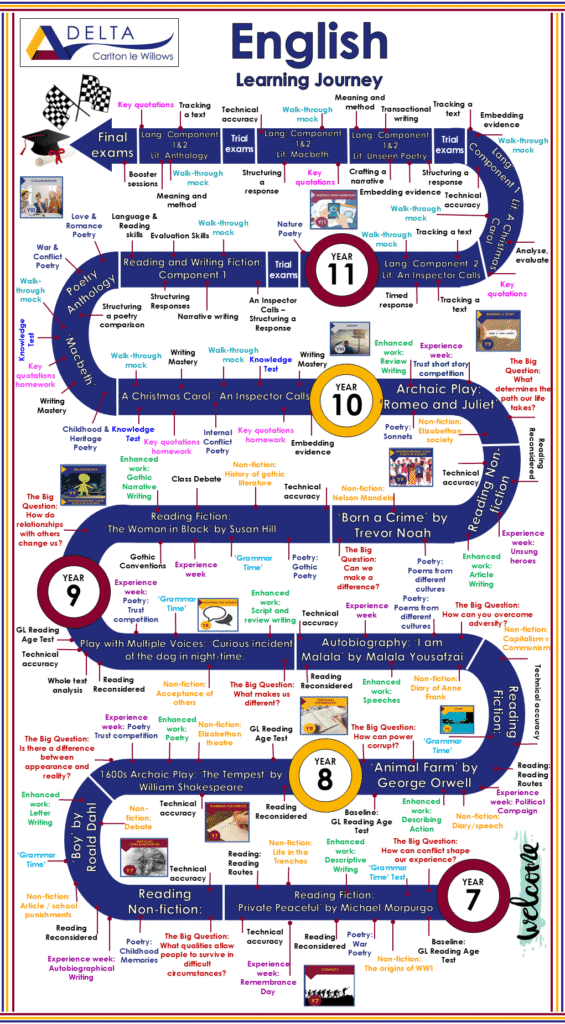
English lessons at Key Stage 3 are focused on the mastery of reading and writing. Using our bespoke secondary English reading strategy students are exposed to a range of challenging texts and taught to develop a multi-faceted skillset as a reader. Students are also given the opportunity to craft and progress as writers, mirroring the different genres and styles of the texts they are reading.
KS4
In Year 10, students are taught the specific knowledge of the texts they study for the English Literature GCSE. We use the EDUQAS exam board and we study An Inspector Calls, A Christmas Carol, Macbeth and an anthology of poetry. Students read and learn the ‘story’ for each text before being taught how to master writing about each text. Retrieval of key ideas, plot and quotes is central to each lesson. As the year progresses, students are introduced to the English Language GCSE, specifically the first component which is focused on reading fiction and writing narratives. Through our bespoke strategy, Students are taught how to master the reading and writing skills necessary to be successful in this component. The year ends with the execution of the Spoken Language component, with students able to express their ideas through talks, debates and presentations.
At the start of Year 11, students are taught the second English Language GCSE component, following the strategy developed. The rest of the Year 11 is focused on the preparation for each exam and component, with regular Walking Talking Mocks, revision, intervention and Trials introduced to ensure students know how to be successful for the final exams.
KS5
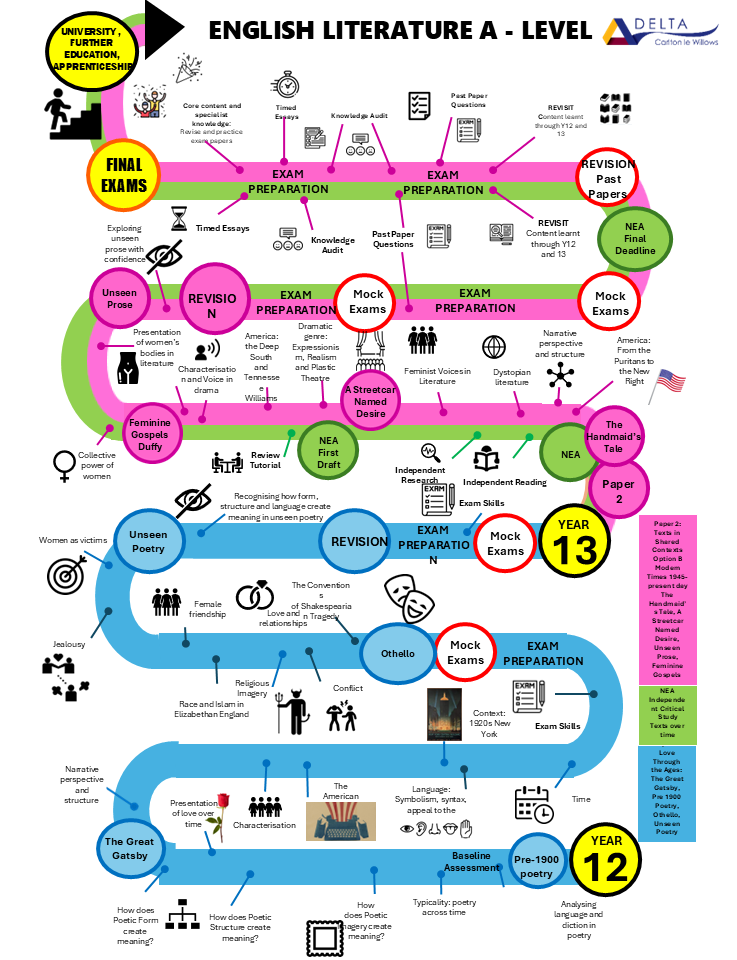
We offer two A-levels, English Language and Literature and English Literature. In both courses, teaching bridges the gap from GCSE, building on the skills and knowledge students have already acquired at Key Stage 4 and slowly instilling a new focus on personal reading approaches, independent thought, reading around texts and exploring a range of different forms, genres and contexts.
| Pedagogy | Enrichment | Other general principles |
| Our pedagogy is underpinned by: * a rigorous and systematic approach to the teaching of reading, adopting the principles and practice recommended in ‘Reading Reconsidered’ by Doug Lemov * the regular use of I do/We do/You do and live modelling to demonstrate processes, standards and expectations * a range of strategies to deepen knowledge so that it is committed to long term memory, including mini-whiteboard drills and use of word walls * a need to ‘normalise error’ so that teachers can pre-empt error as part of their planning to address gaps swiftly, and students see error as a learning opportunity, emphasised by our FIX IT NOW initiative * the importance of giving students regular opportunities to improve and redraft work * the use of live marking and visualisers to give student regular feedback * the use of Walking Talking Mocks to train students in our exam strategy | We will enrich our curriculum by: * establishing cross-curricular links * providing regular on and off-site subject or topic related experiences * holding Trust-wide competitions to celebrate best work and extraordinary effort * encouraging students to contribute to the life of the school and the community, including charity work, and use these ‘real’ contexts to develop their skills and knowledge in English * developing partnerships with external providers that extend children’s opportunities for learning * creating a dedicated enrichment programme at KS3 to offer interactive ways to engage with key topics * providing a range of reading clubs at Key Stage 3. Providing weekly revision sessions at Key Stage 4 and Key Stage 5. | Our curriculum will enable students to: * learn within a coherent and progressive framework * develop new skills through a variety of interesting contexts to foster enjoyment * develop a rich and deep subject knowledge * understand what they are doing well and how they need to improve * explore the breadth and depth of the national curriculum * build on their understanding of the importance of British values, including democracy, the rule of law, individual liberty and tolerance and respect * improve their spiritual, social, moral and cultural understanding to develop autonomy around their own reading choices * demonstrate the progress and development from Key Stage 3 to Key Stage 5. |